How to Source Custom Steering Wheels Directly from Manufacturers: A Reseller Guide
Reviewed by ArmorKun Engineering Team
Buying custom steering wheels factory-direct can improve margins and product control, but only when the supplier is properly verified. This reseller guide explains how to evaluate manufacturers, confirm compatibility, structure an RFQ, test samples, control quality and move safely into bulk orders.
Seeking out custom steering wheel manufacturers from outside it may seem like a straightforward process of searching out a factory, ordering a catalog, comparing prices and ordering – but it really isn’t.
That’s not a typical occurrence.
Price is easy.
The difficult part is determining whether the company quoting you actually manufactures the steering wheel, understands the vehicle platform you intend to sell it for, can reproduce the same specification six months later, and has enough control over materials, electronics, fitment and quality inspection to support a reseller business rather than a one-off purchase.
What happens when the cheapest wheel generates 8% returns?
That is where sourcing economics change.
For a reseller, the relevant number is not simply factory unit price. It is the landed, sellable, repeatable cost per steering wheel after defects, freight, customer returns, installation problems, replacement shipments and support time are included.
We therefore evaluate steering wheel sourcing differently from ordinary accessory purchasing. A steering wheel sits directly between the driver and the vehicle. Depending on the model, it may interface with multifunction buttons, heating circuits, paddle shifters, vibration motors, wiring harnesses, driver-assistance controls and the original airbag mounting system.
That makes supplier selection an engineering decision as much as a purchasing decision.
Why Source Custom Steering Wheels Directly from Manufacturers?
For resellers, the strongest argument for factory-direct sourcing is not simply “lower price.” It is control.
That matters when you are building a catalog rather than buying one wheel.
The reseller might end up supporting hundreds of configurations on the BMW, Mercedes, Audi, Volkswagen, Porsche, Toyota, Nissan and Lexus platforms. When BMW F30, F10, G20, F80 and F90 finally begin to show up in the same purchase order, it’s time for informal communication to become perilous.
Factory access also shortens the technical feedback loop.
If a button harness is wrong, you want the engineer or production team involved quickly. If a carbon finish has changed between batches, you need access to production records. When your customer requests an exclusive, leather and carbon, setup, you need a person who can make an exclusive.
However, ‘factory-direct’ does not necessarily mean ‘good’.
A weak manufacturer is still a weak supplier.
And a competent trading company with strong technical control may outperform a small factory with poor documentation. The objective is therefore not to eliminate every intermediary. The objective is to know exactly who controls production, who owns the technical specification and who is responsible when something fails.
What Types of Custom Steering Wheels Can Manufacturers Supply?
A capable custom steering wheel factory should be able to separate cosmetic customization from structural and functional configuration.
Those are not the same thing.
A reseller might encounter the following product groups:
Steering Wheel Type
Typical Features
Reseller Use Case
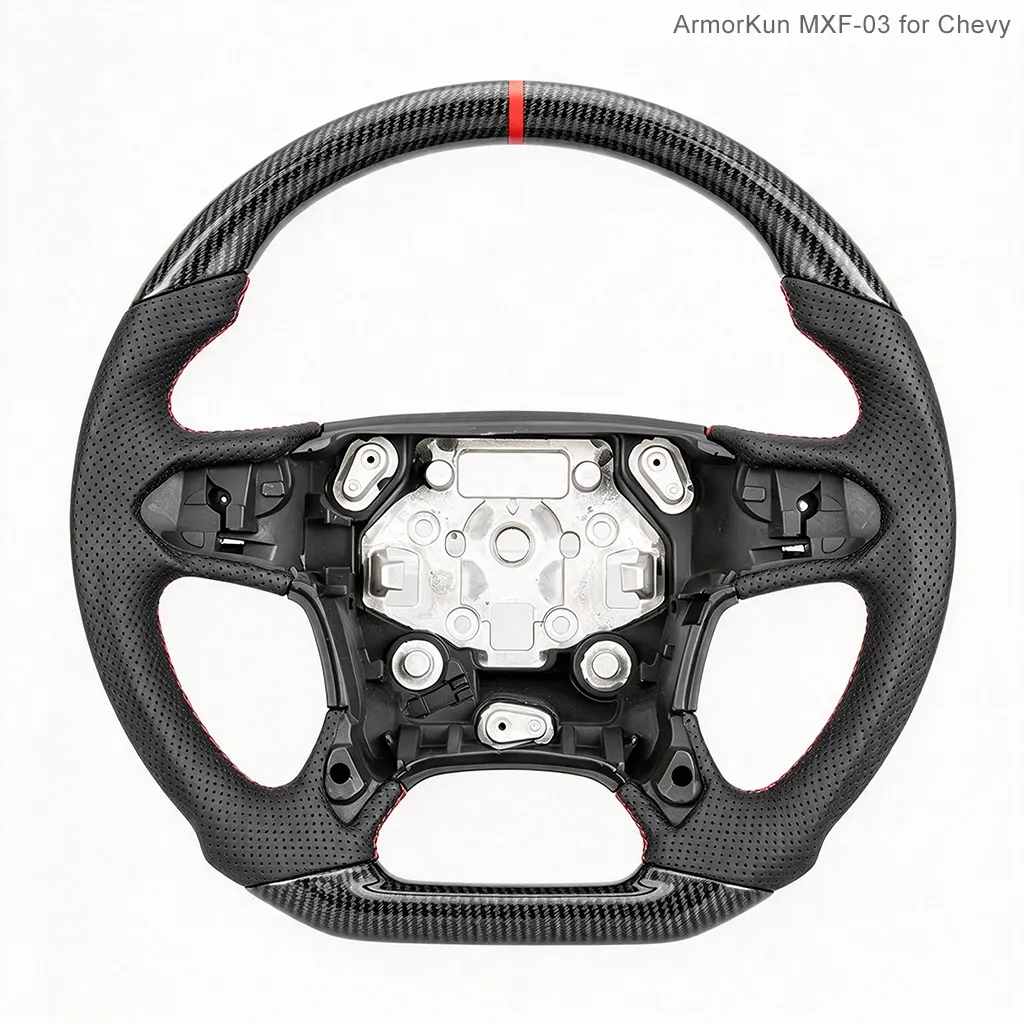
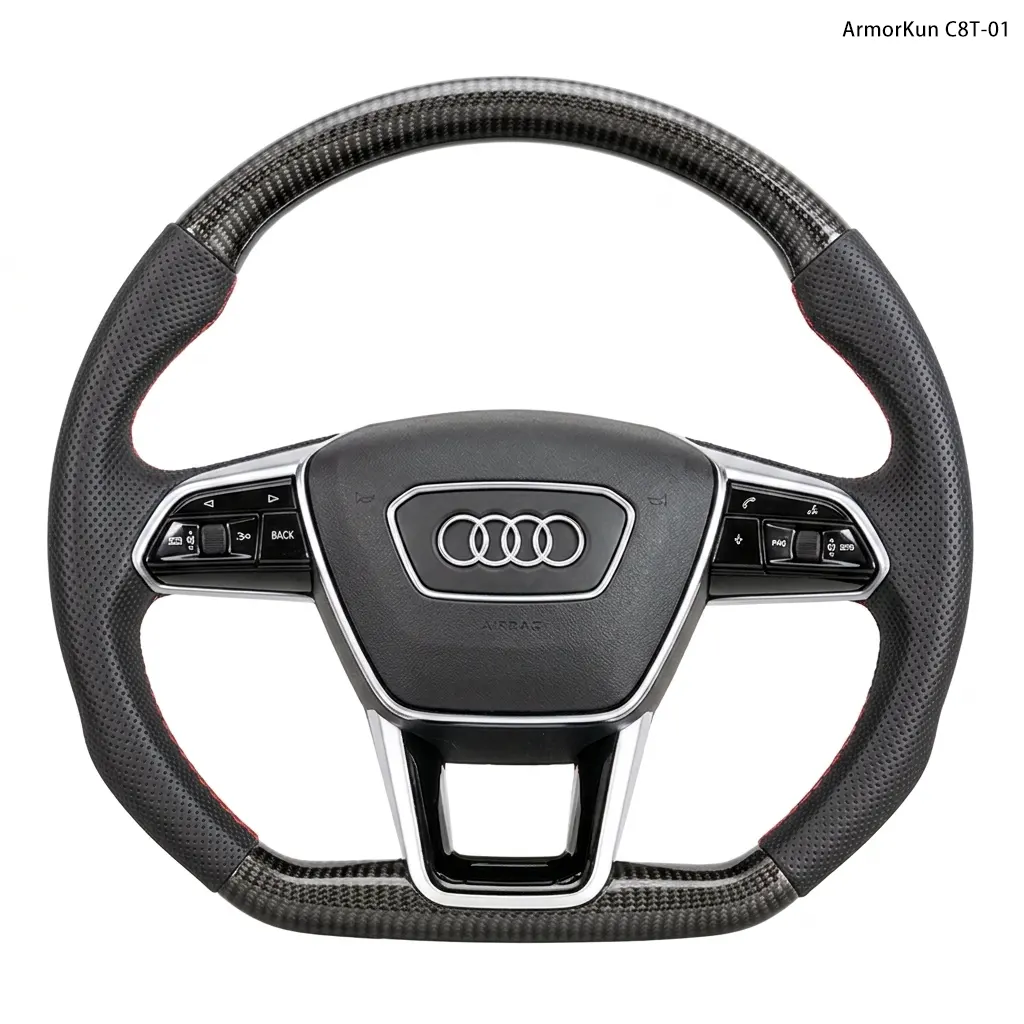
Carbon fiber steering wheel
Gloss, matte, twill or custom carbon sections
Performance and premium aftermarket
Forged carbon steering wheel
Randomized forged-carbon appearance
High-value visual upgrades
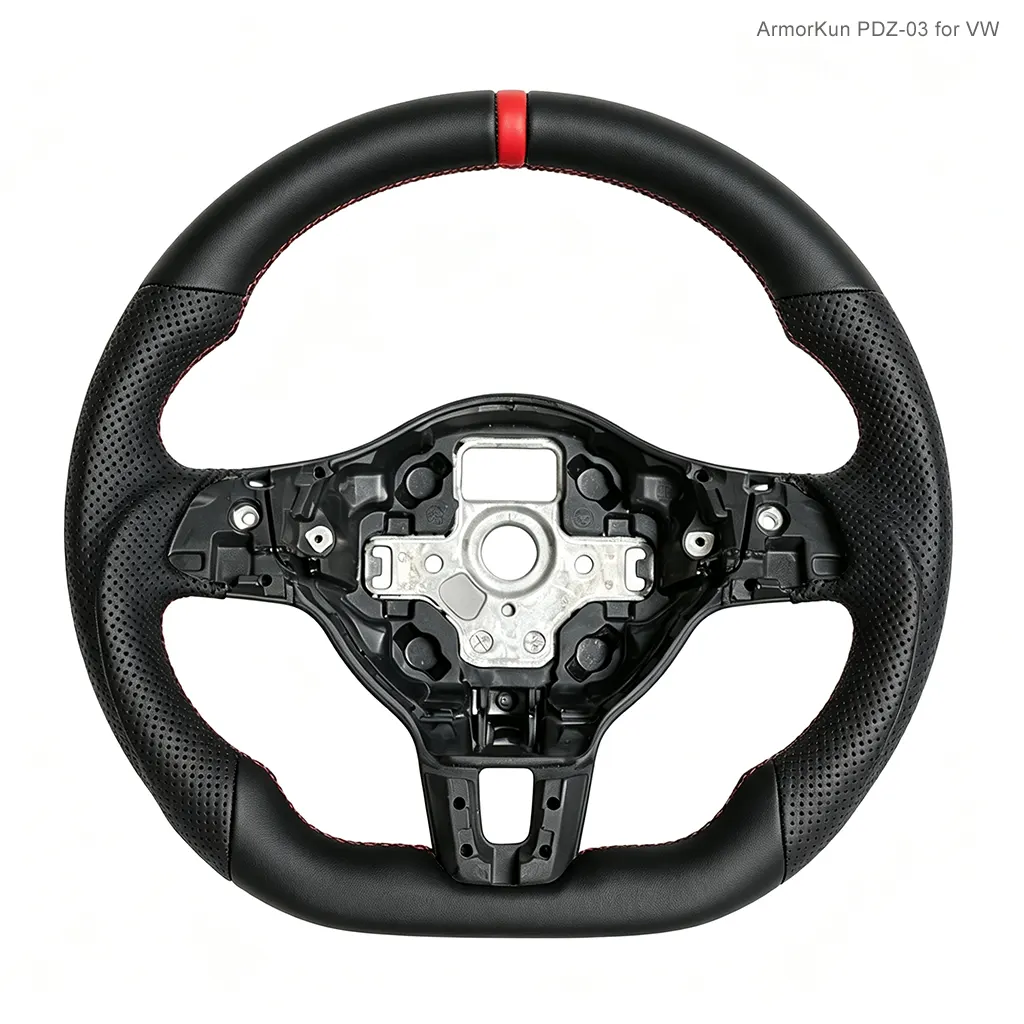
Leather steering wheel
Nappa or genuine leather grip sections
Luxury and daily-driver upgrades
Alcantara steering wheel
Suede-like grip surface
Sport and performance applications
Flat-bottom steering wheel
Modified lower rim geometry
Sport-oriented upgrades
Heated steering wheel
Integrated heating element
Cold-climate and premium customers
LED steering wheel
RPM LEDs and digital display
Performance-focused market
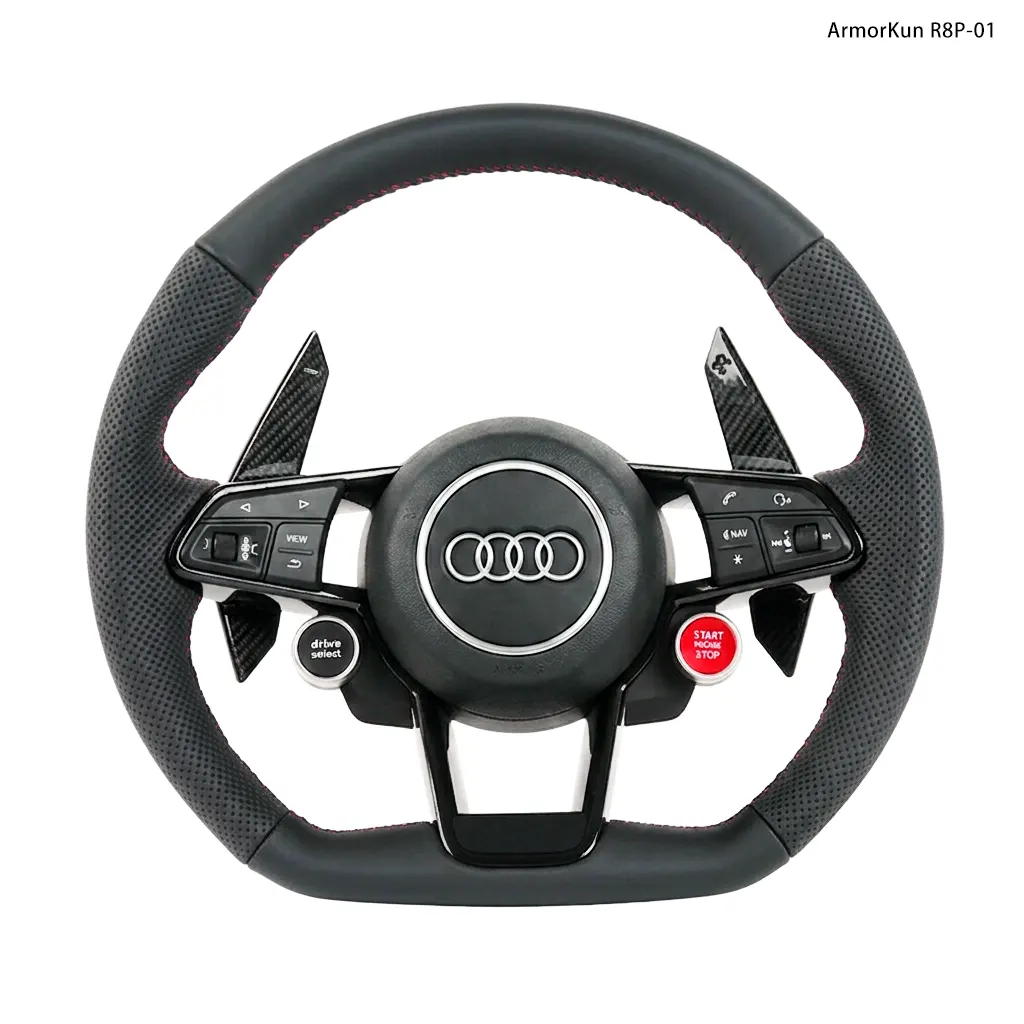
Paddle-shifter steering wheel
Standard or extended paddles
Automatic and performance vehicles
Multifunction steering wheel
Vehicle-specific buttons and controls
OEM-compatible upgrade market
Private-label steering wheel
Custom specification and packaging
Distributors and established resellers
The phrase OEM compatible needs discipline.
It should imply that the after-market product is based on a specific original vehicle interface or function. It means the steering wheel is not an OEM BMW, Mercedes-Benz, Audi or Porsche part and an aftermarket supplier must not claim that an OEM has authorized their part if it does not.
That separation is a safeguard for resellers, both for their reputation and product positioning.
How to Find a Reliable Custom Steering Wheel Manufacturer
Supplier leads can be obtained from Google, Alibaba, Made-in-China, industry referrals and trade shows.
They are unable to check who these are.
That’s important because the automotive supply chain is massive in size. In September, 2024, according to Reuters, there were almost 900 Chinese automotive suppliers taking part in the show, and in total there were about 4,200 companies from over 170 countries participating in the event. The scale demonstrates how many suppliers global buyers can access, but abundance creates its own screening problem. Reuters reported on the supplier presence at Automechanika Frankfurt.
We would not approve a supplier because it has an attractive website.
Instead, verify several layers.
Confirm the Legal Business
Ask for:
Registered company name
Business license
Factory address
Exporting entity
Bank beneficiary name
Certification documents
Company domain email
Years of manufacturing activity
The names should make sense together.
If the quotation comes from Company A, the invoice is from Company B, the payment account belongs to Company C and production supposedly happens at Factory D, ask why.
There can be legitimate reasons. But they should be explainable.
Ask for Production Evidence
Request evidence showing actual manufacturing activities such as:
Steering wheel structural modification
Carbon processing
Leather cutting
Stitching
Surface finishing
Assembly
Wiring
Button installation
Heating integration
Functional testing
Final inspection
Packaging
A five-minute live video call through the production area can reveal more than 50 pages of sales material.
Verify Certifications
Do not simply ask, “Are you ISO certified?”
Ask for the certificate number, issuing body, scope and expiration date.
Then verify it.
A certificate covering an unrelated trading entity tells you very little about the factory producing your order.
Test Communication Before Testing Price
Send a deliberately technical RFQ.
If you provide a model such as a BMW F30 3 Series but omit the model year and original wheel photo, a competent aftermarket steering wheel manufacturer should ask for missing compatibility information.
A supplier who immediately answers “yes, compatible” is giving you a warning for free.
What to Consider Before You Select a Steering Wheel Manufacturer?
The guiding rule is that we evaluate the supplier after the first sample and not before!
Sales teams are optimized to win orders. Production systems determine whether those orders become profitable.
A reseller can build a supplier scorecard like this:
Evaluation Area
Suggested Weight
What to Verify
Vehicle compatibility capability
20%
Model, year, chassis, wheel generation, functions
Manufacturing capability
20%
In-house operations, equipment, capacity
Quality control
15%
Incoming, in-process and final inspection
Electronics integration
15%
Buttons, heating, LEDs, paddles, wiring
Material expertise
10%
Carbon, leather, Alcantara, PU, trim
Technical communication
10%
RFQ accuracy, drawings, change control
Export experience
5%
Documentation, packaging, freight
Traceability
5%
SKU, batch, inspection and complaint records
A supplier scoring 95 on presentation and 45 on compatibility is not a 70-point supplier.
It is a risky supplier.
Pay particular attention to change control. Once you approve a sample, ask how the factory prevents somebody from changing leather, adhesive, wiring, carbon finish or packaging later because a cheaper material became available.
That question separates manufacturing systems from workshops.
What Information Should You Include in a Steering Wheel RFQ?
A vague RFQ produces a vague quotation.
“BMW carbon steering wheel, price please” is not enough.
A serious steering wheel RFQ should include:
Vehicle make
Vehicle model
Model year
Chassis code where available
Country or regional version
Left-hand-drive or right-hand-drive specification where relevant
Photos of the original steering wheel
Front image
Rear image
Button layout
Paddle configuration
Original heating function
Required material
Carbon fiber style
Leather or Alcantara selection
Stitching color
Center stripe requirement
Flat-bottom or round design
Thumb-grip design
LED requirement
Paddle-shifter requirement
Button requirement
Required OEM-compatible functions
Order quantity
Sample quantity
Private-label requirements
Packaging specification
Destination country
Requested Incoterm
Photos matter.
A vehicle name alone may cover several steering wheel generations.
For example, “BMW 3 Series” could refer to E90, F30 or G20 generations, and even within one chassis family, Sport, M Sport and other configurations may use different trims, buttons, wiring or airbag geometry.
The RFQ should remove ambiguity before the price is agreed.
Not after production.
How Do Manufacturers Verify Vehicle and OEM Compatibility?
The pairing for a good match-up should be able to resolve four different questions:
Mechanical compatibility: Does the steering wheel structure fit the intended steering column and mounting arrangement?
Airbag interface compatibility: Does the wheel preserve the required geometry and mounting arrangement for the correct original safety system?
Electrical compatibility: Are connectors, buttons, heating elements, paddle shifters and other circuits configured correctly?
Functional compatibility: Do the features the reseller promised actually work in the target vehicle?
That is why “fits BMW” means almost nothing.
While the steering wheels may appear to be interchangeable in photos online, a BMW F10 5 Series, F30 3 Series, F80 M3, F90 M5 and G20 3 Series are not interchangeable.
Parts associated with Airbags are even more sensitive.
In July 2024, the U.S. National Highway Traffic Safety Administration (NHTSA) announced a recall because of a safety concern for potentially life-threatening injuries and fatalities caused by faulty aftermarket replacement airbags that were installed in previously damaged vehicles. NHTSA specifically advised consumers to question unusually cheap overseas replacement components and verify the source of airbag parts. Read the 2024 NHTSA consumer alert.
This is not an argument against aftermarket steering wheels.
It is an argument against treating an airbag inflator like decorative trim.
The distinction should be written into your procurement policy.
A custom steering wheel reseller should identify exactly what the manufacturer supplies and what original components are intended to be retained. Undocumented or counterfeit airbags and inflators should never be treated as a shortcut to creating a “complete steering wheel.”
The legal implications are no figment of imagination either. The U.S. Department of Justice announced in May 2025 that a Tennessee defendant was sentenced to two years in prison after importing parts for motor-vehicle airbag systems from China and building counterfeit airbags and selling them online for about $100 to $725 apiece. The full details are in the case brought by the Department of Justice.
The occupant crash protection requirements are set forth in 49 CFR §571.208 for U.S. buyers, and NHTSA has also clarified that the design of the steering wheel may impact compliance with FMVSS Nos. 203, 204 and 208.
Compliance review of the countries in which importers and resellers do business must be established by the importer/reseller, as it can vary from market to market.
What Customization Options Are Available for Steering Wheels?
Customization should be divided into material, geometry, appearance and function.
Otherwise the specification becomes messy very quickly.
Carbon Fiber
Common options include:
Standard woven carbon fiber
Forged carbon
Gloss finish
Matte finish
Colored accents
Partial-carbon layouts
A reseller should approve the actual carbon appearance rather than writing only “carbon fiber” on the purchase order.
We have seen buyers debate weave alignment after production even though weave direction was never defined in the RFQ.
That is preventable.
Leather and Alcantara
Possible grip materials include:
Nappa leather
Perforated leather
Smooth leather
Alcantara
Microfiber suede
Mixed-material layouts
Specify not only material type but also:
Surface texture
Perforation
Grip section
Thread color
Stitch pattern
Center stripe
Thickness
Geometry
Common changes include:
Flat bottom
Thickened rim
Sculpted thumb grips
Modified side grips
Performance-style lower spokes
Here the reseller must distinguish between a visual modification and an ergonomic one. A rim that photographs well but feels oversized during daily driving may generate poor reviews.
Functional Upgrades
Depending on the vehicle and configuration, manufacturers may offer:
Heating
LED RPM indicators
Digital displays
Multifunction buttons
Paddle shifters
Extended aluminum paddles
Vibration-related functions
Vehicle-specific wiring
Every additional electronic function adds another failure point.
So test it.
A beautiful carbon steering wheel with one dead button is not a 95% successful product. To the customer who cannot use cruise-control commands, it is defective.
What Are the MOQ, Sample and Pricing Requirements?
There is no meaningful universal MOQ for custom steering wheels.
MOQ changes with the product.
A factory may accept one engineering sample while requiring a different quantity for private-label packaging, exclusive molds, specialized carbon finishes or custom electronic modules.
For resellers, we prefer to separate three stages:
Engineering sample: One configuration used to confirm what the supplier can physically produce.
Commercial pilot: A small controlled batch, for example 5–10 units where practical, used to check consistency, packaging, installation feedback and customer response.
Bulk order: Production begins only after the specification and pilot results are accepted.
Do not negotiate only the unit price.
Ask the supplier to separate:
Base wheel cost
Carbon upgrade
Forged-carbon upgrade
Leather or Alcantara upgrade
Heating
LED display
Paddle shifters
Buttons
Custom trim
Tooling
Sample charges
Private-label packaging
Spare-part allowance
Export packaging
Freight
And compare quotations under the same Incoterm.
An EXW quote and a DDP quote are not competing prices.
Suppose Supplier A costs $20 less per wheel but creates enough compatibility complaints to require repeated international replacement shipments. The cheaper factory can become the more expensive business partner surprisingly fast.
How Do Steering Wheel Manufacturers Control Product Quality?
Quality control should start before assembly.
By the time a finished steering wheel reaches final inspection, some defects are already expensive to correct.
A useful QC plan can include:
Incoming Material Inspection
Check:
Carbon materials
Leather
Alcantara
Thread
Trim parts
Electronic modules
Connectors
Paddle components
Packaging materials
Structural and Dimensional Inspection
Critical dimensions should be controlled against an approved reference, drawing, fixture or sample.
Do not rely on visual comparison alone.
Surface Inspection
Carbon products should be checked for issues such as:
Surface contamination
Resin defects
Uneven finish
Visible bubbles
Distortion
Poor transition between materials
Inconsistent weave presentation
Leather sections should be checked for:
Wrinkles
Adhesion
Stitch consistency
Seam alignment
Surface damage
Grip symmetry
Functional Testing
Where applicable, verify:
Multifunction buttons
Heating
LEDs
Displays
Paddle operation
Wiring connections
Final Configuration Check
The label on the box needs to match the product inside it.
Obvious?
Yes.
Yet once a reseller orders multiple BMW, Audi or Mercedes-Benz configurations with similar-looking wheels, SKU mistakes become an operational risk.
Build traceability.
Every repeated configuration should have a product code or specification record that links the wheel to its approved material, functions, vehicle application and packaging.
For bulk orders, buyers can also define an inspection sampling plan in the purchase order rather than arguing about acceptable defects after production.
Manufacturer vs. Trading Company: Which Is Better?
The factory is not automatically the winner.
That may sound strange in a factory-direct sourcing guide, but it matters.
A specialized steering wheel manufacturer usually has an advantage when the reseller needs deep customization, repeated engineering changes or private-label development. A strong trading company may be better when the buyer wants many unrelated automotive products consolidated from several factories.
The real comparison looks more like this:
Factor
Direct Manufacturer
Trading Company
Custom steering wheel development
Usually stronger
Depends on factory relationships
Technical communication
More direct
Extra communication layer
Factory pricing visibility
Usually higher
Margin may be bundled
Multi-category sourcing
Limited to factory scope
Often stronger
Mixed supplier consolidation
Limited
Strong
Production problem solving
Direct access
Depends on intermediary
Private-label development
Strong when factory supports ODM
Variable
Small mixed orders
Depends on factory
Can be flexible
Quality accountability
Clear if factory system is mature
Depends on trading company’s QC
Engineering change control
Usually easier
Can become slower
So what should a reseller choose?
Choose the organization that controls the risk you care about.
If you sell highly customized BMW steering wheels and need repeatable carbon, leather, buttons, heating and model compatibility, direct manufacturer access has substantial value.
If your catalog contains steering wheels, headlights, bumpers, floor mats and hundreds of unrelated accessories, a capable sourcing company may reduce administrative complexity.
The mistake is pretending a trader is a factory.
Transparency matters more than labels.
How Does the Factory-Direct Steering Wheel Sourcing Process Work?
We recommend turning factory sourcing into a controlled sequence rather than negotiating everything through scattered WhatsApp messages.
A workable process looks like this:
Define the product category
Decide which vehicles and steering wheel types you actually intend to sell.
Do not request “all BMW models” on day one unless you already understand the inventory burden that creates.
Build a supplier short list.
Use search engines, industry directories, trade shows, referrals and b2b directories to find manufacturers.
Verify each supplier
Check company registration, manufacturing evidence, certificates, factory capability and export experience.
Send a structured RFQ
Provide vehicle information, photographs, functions, material specifications, quantity and destination.
Compare technical responses before price
Which supplier asked better questions?
That is data.
Freeze the sample specification
Document the materials, geometry, stitching, functions, packaging and intended compatibility.
Order a sample
Inspect the actual wheel rather than relying on rendered images.
Install and test
Where appropriate, have the sample evaluated by qualified personnel on the intended vehicle configuration.
Run a pilot order
For a reseller, a small commercial batch can expose consistency problems that one perfect sample will never reveal.
Approve bulk production standards
Keep an approved sample, specification sheet, photos or drawings as the production reference.
Conduct pre-shipment QC
Check product configuration, cosmetic quality, functions, quantities, labels and packaging.
Record field feedback
Returns are engineering information.
Track complaints by SKU, vehicle, production batch and problem type. If three customers report the same button issue, stop calling those cases isolated incidents.
That is how a steering wheel sourcing operation becomes scalable.
FAQs
Is it possible to purchase custom steering wheels directly from a manufacturer?
Dealers who buy directly from a custom steering wheel manufacturer have the ability to communicate with the engineering, production, inspection and manufacturing department directly, which offers them more control of the steering wheel specifications, samples, pricing structure, feedback, quality records and repeat orders with the factory, as opposed to only the reseller who does not participate in engineering, production, inspection and feedback from the manufacturing process.
Yes. Companies that offer reseller software and services, distributor software, automotive accessory brands and limited service brands and car repair shops.
The important question is not whether direct purchasing is possible. It is whether the manufacturer can consistently support your required vehicle platforms, functions, customization level, quality standard and order volume.
What is a MOQ for custom steering wheels?
MOQ for custom steering wheels depends on the minimum number of production wheels that a factory will accept for a given steering wheel version, and is dependent on steering wheel platform, carbon pattern, leather color, electronic functions, tooling requirements, packaging, sample production, pilot production, mixed model production and repeat production orders.
Ask for separate terms for samples, mixed-model orders and bulk production.
A reseller ordering 20 wheels across five established configurations creates a different manufacturing problem from a buyer requesting 20 completely new designs.
How do I know if a supplier is a genuine steering wheel manufacturer?
The best methods for confirming a steering wheel factory is to consult legal business records, check for certifications, see actual production in evidence, view equipment lists, process documentation, sample testing, and video production or even third party factory audits since a website, market place badge, low quotation or salesperson cannot prove who makes the product.
Check the address that appears on the business license, certificate, quotation and shipping paperwork.
And ask technical questions.
Factories do not have to know every answer instantly, but somebody inside the organization should be capable of answering manufacturing questions without repeatedly “checking with our supplier.”
Can the aftermarket steering wheel replace the OEM airbags, buttons and functions?
An aftermarket steering wheel for an OEM compatible application should be compatible with the vehicle application interface as well as retain all of the specified functions; OEM-compatible does not imply OEM part; compatibility must be confirmed for all aspects of the steering wheel (mechanical hub, airbag mounting geometry, buttons, wiring, heating, paddles, sensors and trim).
This is why photographs of the original wheel and precise vehicle information matter.
Do not assume two visually similar steering wheels use identical electronics or safety-system interfaces.
For airbag-related work, use the correct genuine safety components where required and follow the applicable vehicle manufacturer, installer and market regulations.
Should resellers order a sample first before they place a wholesale steering wheel order?
There is a sample order process, where a representative sample should be ordered and approved before committing to bulk production, as the sample will provide a tangible representation of the drawings, images, material name and sales commitments as they relate to fitment, grip profile, stitching, carbon finish, button operation, heating, paddle response, packaging quality and installation behaviour.
But one sample is not proof of production consistency.
That is why we prefer a second stage: the pilot batch.
A supplier can spend extraordinary attention on one sample. Producing the same result repeatedly is the real manufacturing test.
What are the details I need to include when enquiring for a steering wheel quote?
The following should be considered when drafting an RFQ for a steering wheel: the make and model of the vehicle, the coding of the wheel, photographs of the original wheels, the current layout of buttons and paddles, materials being requested, shape, stitching, heating or LED functions, anticipated order volume, destination country, packaging requirements, and any OEM-compatible functions that will need to be maintained after installation.
The more detail that is included the more accurate the quotation will be.
For resellers carrying several vehicle platforms, create one specification sheet per configuration. Do not allow product requirements to live only inside chat histories.
That becomes unmanageable once repeat orders begin.
Build the Supply Chain Before Building the Catalog
The reseller who wins is not necessarily the one who finds the lowest factory price.
It is the one who can reorder the same product.
Again. And again.
That requires a custom steering wheel supplier capable of converting vehicle data, materials, functions and design choices into controlled specifications rather than relying on photographs and memory.
If you are just starting to search for a custom steering wheel manufacturer, you should first get 5 pieces of information before you request a quotation:
Vehicle make and model
Model year or chassis
Clear photographs of the original steering wheel
Required materials and functions
Estimated sample and bulk quantities
Send those first.
At ArmorKun, we work with aftermarket resellers, distributors and automotive businesses on vehicle-specific custom steering wheel programs, including carbon fiber, leather, Alcantara, heated, multifunction and other customized configurations. For a new project, the most useful starting point is not “What is your cheapest steering wheel?” but “Here is the vehicle, here is the original wheel, and here is exactly what our market needs.”
That is how a serious sourcing conversation starts.
Leo Wu Industrial Design Manager 10+ Years in Automotive Steering Wheel Design Expertise: carbon fiber, Nappa leather, OEM development, performance steering wheels
Over 10 years of experience in steering wheel development, premium materials and OEM manufacturing, Leo Wu is an automotive interior expert. Strictly cooperates with ArmorKun production teams, applies performance and focuses on steering wheel design and construction, leather processing and high-level function integration, in luxury cars and sports vehicles.







 English
 German
 French
 Italian
 Dutch
Dutch Russian
 Polish
 Spanish
 Arabic
 Japanese
 Korean