From 10 BMW Steering Wheel Samples to a 5-Year Partnership: A Custom Steering Wheel Supplier Case Study
Reviewed by ArmorKun Engineering Team
This custom steering wheel supplier case study explains how a Canadian automotive client assessed quality, customizability and reliability of production before embarking on a five-year partnership. Prototype samples, development cooperation and beyond, we explore the process of supplier selection in successful aftermarket steering wheel projects.
Ten samples made all the difference. The initial request ArmorKun received from a Canadian automotive company seemed straightforward: Make a set of 10 BMW custom steering wheel samples for evaluation. For the 10 units, however, there was also a much larger question to be answered—one that included the quality of the product, engineering capacity, the availability of supplies, and the potential for a serious long-term business relationship with the manufacturer.
In the automotive aftermarket industry, the first order is not the real test.
The true measure is to be found later.
Will the supplier be able to sustain a steady quality with 100 units? After 1,000 units? Will they be able to manage a range of different BMW platforms, evolving customer needs, bespoke materials, and production schedules, without compromising on quality?
The problem with a lot of suppliers is that they stop there.
The steering wheel isn’t a leathery item. It brings together all aspects of structural engineering, electronics integration, safety, material processing, and brand identity. When it comes to custom steering jwels suppliers, the ideal manufacturing partner can make the difference between success and failure, or it can keep an item as one of their most repeat selling products.
The challenge starts here: how to get 10 samples to be a market-ready product.
Little orders show great trouble.
This is because a prototype may have amazing look in the picture, but not show the manufacturing problems when it is manufactured in large quantities. Some failures in supplier evaluation are due to uneven carbon fiber pattern, inconsistent stitching tension, poor leather fitting, button compatibility issue and incorrect dimension.
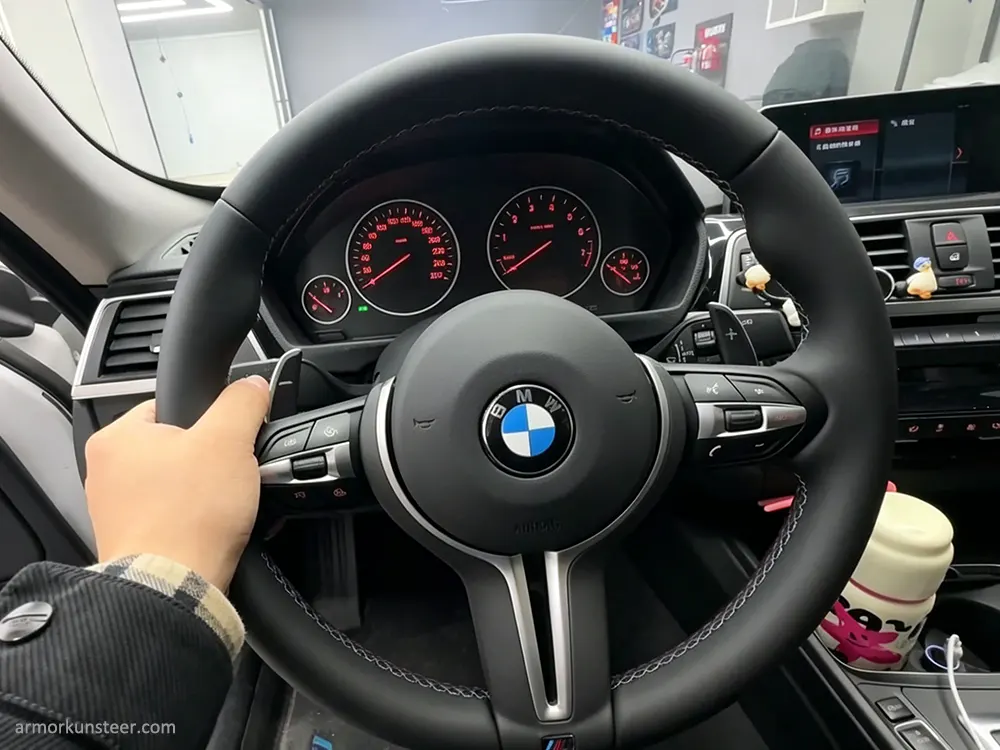
Our Canadian client started with only 10 BMW steering wheel samples.
But the evaluation process focused on much more than appearance.
The client reviewed:
OEM-style fitment accuracy
Leather wrapping quality
Carbon fiber finishing consistency
Paddle shifter compatibility
Multifunction button integration
Packaging protection
Communication efficiency
This is in line with wider automotive sourcing trends.
More companies consider manufacturing systems as a basis for judging the suppliers. According to research from International Trade Administration, automotive supply chains depend heavily on supplier reliability, quality management, and production consistency rather than simple price competition.
The cheapest supplier is rarely the safest supplier.
Why BMW Steering Wheel Projects Require More Than Manufacturing Ability
BMW steering wheels are a good example of why aftermarket customization requires specialized knowledge.
Different BMW generations use different electronic systems.
For example:
BMW F-series platforms (approximately 2010–2019) use different communication systems compared with newer G-series models.
BMW M Sport steering wheels require accurate airbag module positioning.
Paddle shifter versions require correct wiring and signal compatibility.
Heated steering wheels require proper heating element installation.
A supplier producing custom steering wheels must understand both craftsmanship and vehicle engineering.
This is where many trading companies struggle.
They can arrange production.
But they cannot always solve technical problems.
The Five-Year Partnership Was Built on Process, Not Price
Price attracts customers.
Consistency keeps them.
During the five-year cooperation period, the relationship developed through repeated improvements:
Partnership Stage
Client Requirement
Supplier Response
Initial Evaluation
10 BMW steering wheel samples
Prototype development and quality testing
Product Validation
Check appearance and fitment
Adjust leather, carbon fiber, and electronics details
First Production Orders
Stable manufacturing quality
Standardized production procedures
Expansion Phase
More customization requests
Additional materials and design options
Long-Term Partnership
Reliable supply chain
Continuous technical support and production improvement
The automotive aftermarket has little tolerance for inconsistency.
A customer buying one steering wheel expects premium quality. A distributor ordering hundreds expects every unit to match the first sample.
That difference separates hobby-level suppliers from professional manufacturers.
What Professional Buyers Should Look For in a Custom Steering Wheel Supplier
We have seen buyers make the same mistake repeatedly.
They compare suppliers only by quotation.
That approach creates problems later.
A professional evaluation should include five areas:
Vehicle compatibility knowledge is often more valuable than production capacity alone.
2. Material Capability
A serious steering wheel manufacturer should provide multiple material options:
Nappa leather
Genuine leather
Alcantara
Forged carbon fiber
Standard carbon fiber
Hydro-dipped finishes
Aluminum paddle shifters
Material selection directly affects product positioning.
A $300 aftermarket wheel and a $1,500 premium custom wheel may use completely different manufacturing approaches.
3. Engineering Support
Customization creates technical questions:
Does the airbag fit correctly?
Are buttons functional?
Does the heating system work?
Are paddle shifters compatible?
Does the steering angle sensor remain accurate?
A supplier must solve these issues before production.
4. Quality Control System
Automotive buyers should ask:
How are dimensions measured?
Are samples archived?
Are production batches inspected?
Are materials traceable?
Here the distinction between a manufacturer and a reseller may be created.
The Challenge: Real Industry Examples, Why Supplier Relationships Matter.
Strategic supplier partnership has always been the strengths of automotive heavyweights.
A supplier who can be simply treated as a vendor is not a good idea; for example, Tesla Inc. developed its supply chain by close-cooperation with battery and component suppliers.
So premium car brands keep working on their supplier networks. The reason is that the quality of a car really depends on how consistent the partsre
A steering wheel is a part when you compare it to things, like engines or batteries.
But it represents direct customer interaction.
Drivers touch it every second they operate the vehicle.
Repeatability is required in a five-year partnership.
Frequently Asked Questions
How to Select a Dependable custom steering supplier?
The best custom steering wheel supplier is the one who is able to maintain the quality of manufacturing, have the knowledge of the vehicle, is able to customize the steering wheel, and can provide long-term technical support, not just a competitive price. Purchasers should consider samples, manufacturing methods, materials and quality checking prior to production orders.
What is the time frame of a custom BMW steering wheel sample?
The development of a custom BMW steering wheel is usually 2-8 weeks with the design complexity, material choice, electronics, and vehicle application requirements. Engineering validation is typically needed for projects that are carbon fiber, LED, heating or custom paddle shifters.
What are the differences between the OEM and aftermarket steering wheel suppliers?
OEM Steering Wheel Suppliers produce parts that are used by vehicle manufacturers, while after-market Steering Wheel Suppliers like Deal with car brands or car owners to find new steering wheel or upgraded or customized products. Aftermarket suppliers tend to be more geared towards customisation, styling options, and low volumes.
Even a steering wheel company can help grow the future of the car industry?
A professional steering wheel supplier can help maintain the automotive partnership for the long term by ensuring that the product quality is maintained, efficient production line, assistance of new designs and extension of manufacturing capacities with customer orders.
Why was the supplier chosen for five years by the Canadian client?
The Canadian client opted to keep the business going due to a lack of consistent product quality from the supplier, poor communication between the two firms, the inability of the supplier to solve technical issues and the supplier’s inability to help the Canadian company with future modifications beyond the sample order.
From Samples to Strategic Partnership
A successful custom steering wheel project rarely starts with a large purchase order.
It starts with trust.
Those first 10 BMW steering wheel samples were not simply products. They were proof of manufacturing capability.
For automotive brands, distributors, and customization companies searching for a reliable steering wheel manufacturing partner, the right supplier should provide more than production capacity.
They should provide engineering experience, material expertise, and the ability to grow together.
A five-year partnership is not built by making one perfect sample.
It is built by making the thousandth unit with the same attention as the first.
Leo Wu Industrial Design Manager 10+ Years in Automotive Steering Wheel Design Expertise: carbon fiber, Nappa leather, OEM development, performance steering wheels
Over 10 years of experience in steering wheel development, premium materials and OEM manufacturing, Leo Wu is an automotive interior expert. Strictly cooperates with ArmorKun production teams, applies performance and focuses on steering wheel design and construction, leather processing and high-level function integration, in luxury cars and sports vehicles.









 English
 German
 French
 Italian
 Dutch
Dutch Russian
 Polish
 Spanish
 Arabic
 Japanese
 Korean