How to Estimate Total Landed Cost for Custom Steering Wheels
Reviewed by ArmorKun Engineering Team
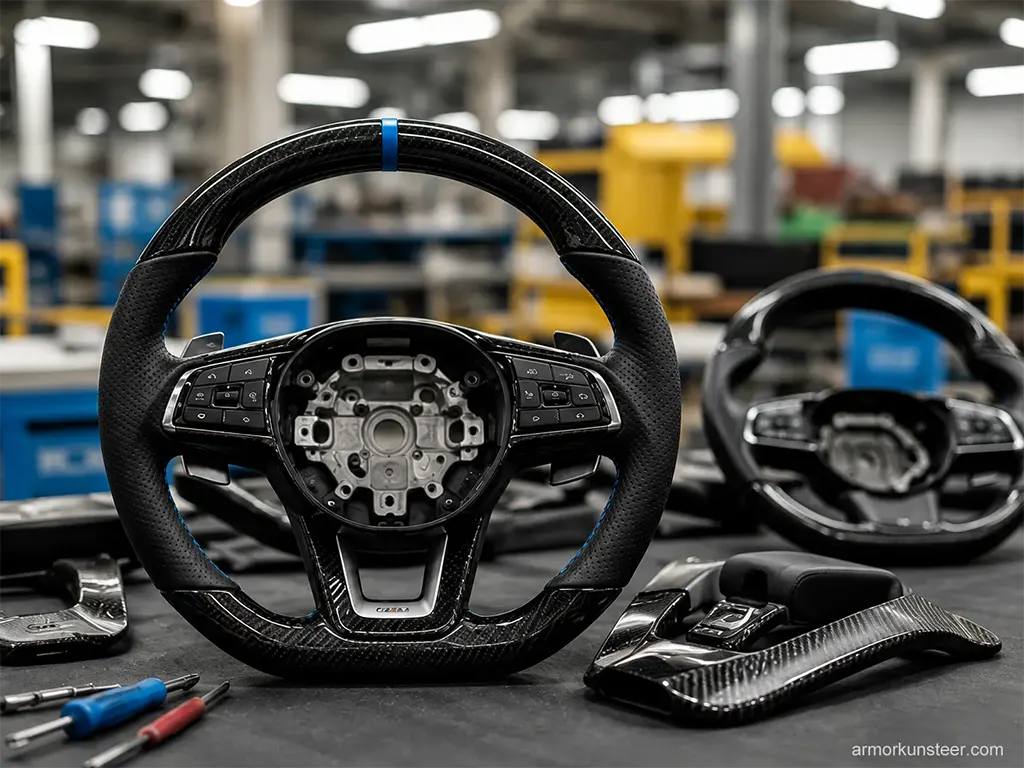
If the importer uses the factory quotation as the sole basis for determining the price of a custom steering wheel then it is a safe bet that he or she will almost always miss the mark. Here are all the costs involved explained, a practical landed cost formula and how professional buyers prevent costly surprises.
Most buyers don’t. Over the years we’ve seen hundreds of RFQs and this is a recurring error in every submission, whether it was for ten steering wheels or the whole container. They only account for factory quotations and do not consider freight, customs, inspection fees, payment charges, inland transportation or inventory carrying costs. It’s not a “darn close” budget. Often a procurement decision based on numbers that never actually existed.
Why does this happen?
Because suppliers compete on FOB price, while experienced importers negotiate around landed cost.
That difference separates companies that protect their margins from those that spend months explaining unexpected costs to management.
If your supplier quotes US$280 for a custom carbon fiber steering wheel, that is almost never your final cost. Depending on destination, shipping method, tariffs, customs classification, and brokerage fees, the actual landed cost may exceed US$400–500 per unit before the product even reaches your warehouse.
Landed cost is the sum of various fees and charges incurred by importers when they buy merchandise, transport it, clear customs and receive the goods at the final warehouse. It covers manufacturing, transportation to international destinations, import taxes, customs clearance, insurance, domestic delivery and all other costs incurred up to the point that the product reaches the customer’s hands. This is the number to look at when deciding who to use when procurement.
Many buyers believe the invoice price determines profitability.
We disagree.
Profit is determined by the number that arrives after every invoice has been paid.
The Complete Landed Cost Formula
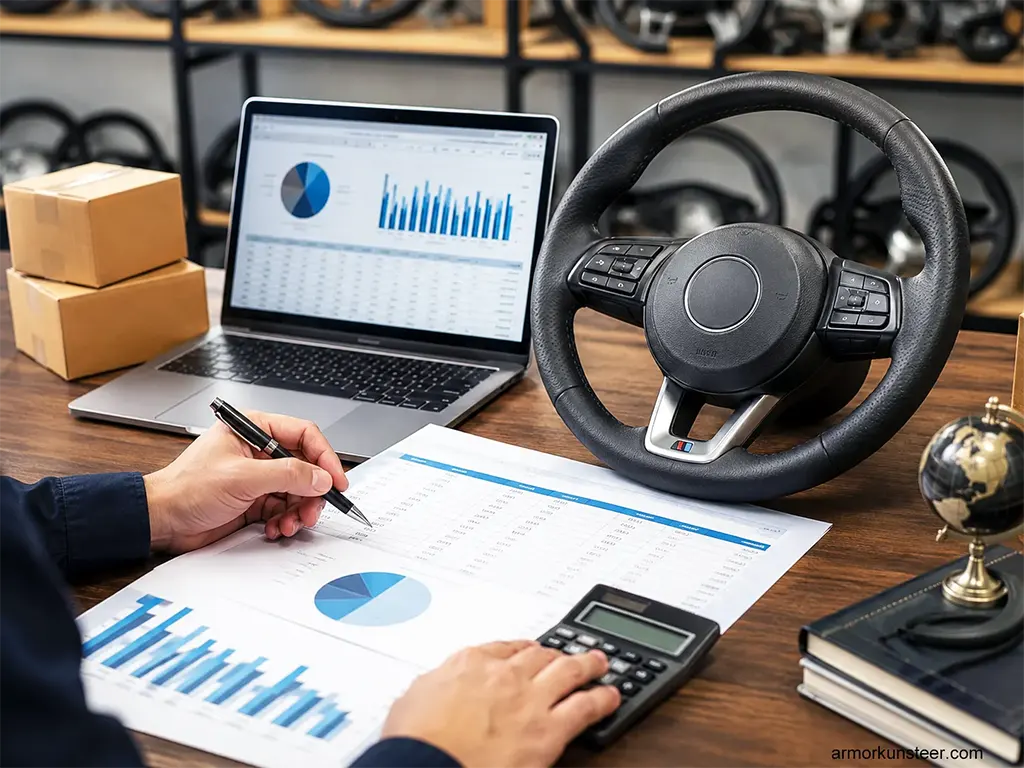
Professional automotive importers generally estimate landed cost using the following structure.
We have witnessed buyers becoming aggressively involved in negotiating prices, and at the same time ignoring freight surcharges which raised their shipment cost by well over US$2,000.
The hidden expenses usually include:
International wire transfer fees
Export documentation
Cargo insurance
Customs broker service
Port storage charges
Container examination fees
Currency exchange fluctuations
Quality inspection
Product testing
Warehouse receiving fees
Packaging redesign
Return reserves for defective products
None of these appear on Alibaba quotations.
Every one of them affects your margin.
Freight Changes Everything
Shipping is rarely a fixed percentage.
Thirty steering wheels air freighted are very different in behavior to 300 steering wheels ocean freighted. Air freight offers quicker lead times, but with much higher freight costs per unit. Ocean freight reduces transportation costs per unit, while giving rise to longer lead times and extra warehousing charges.
They don’t just take the lowest-quote quotation from experienced purchasing managers, who consider the mode of shipment in addition to inventory turnover.
Customs Duty is More Complex Than Most Importers Realise
There are also many buyers looking online for a duty percentage.
This is not an effective strategy.
Duty rates will be based on proper HS classification, country of origin, appropriate trade agreements, and tariff policy. Import duty, U.S. Customs and Border Protection says, is based on the Harmonized Tariff Schedule, and importers may apply for a Binding Ruling if they are unsure how a product will be classified. (CBPCS)
Most important, the declared customs value should reflect the transaction value and other required additions to the transaction value, including commissions, assists, royalties, production costs and packing (where applicable). This can result in penalties if the valuation is incorrect. (CBPCS)
A Practical Example
Suppose you purchase 100 custom carbon fiber steering wheels.
Item
Cost
Factory Price
US$28,000
Ocean Freight
US$2,400
Marine Insurance
US$180
Customs Duty & Tariffs
US$4,200
Customs Broker
US$320
Port Charges
US$450
Inland Trucking
US$650
Banking Fees
US$150
Inspection
US$350
Estimated Total Landed Cost
US$36,700
Your actual cost per steering wheel becomes approximately US$367, not the original US$280 factory quotation.
That difference determines pricing strategy.
Why Professional Buyers Build a Landed Cost Model Before Negotiating
Negotiation begins later.
The first step is understanding your cost structure.
When buyers know every component affecting landed cost, they negotiate differently. Instead of demanding lower product pricing, they may request:
Better packaging density
Different Incoterms
Combined shipments
Alternative ports
Consolidated freight
Longer payment terms
Lower MOQ
Optimized carton dimensions
Those adjustments often reduce total procurement cost more effectively than simply asking for another discount.
Recent Trade Policy Makes Cost Estimation Even More Important
Trade policy has become increasingly dynamic.
For automotive parts entering the United States, customs classification and additional tariff provisions can materially affect import cost. Recent CBP rulings and tariff updates demonstrate how changes in applicable Chapter 99 provisions may increase duties on certain imported automobile parts depending on classification and country of origin. (CROSS)
Importers should be aware that there are also other charges imposed by U.S. Customs, such as the Merchandise Processing Fee (MPF), and (if applicable) the Harbor Maintenance Fee (HMF) for ocean shipments. (CBPCS)
The aforementioned items are not a deal-breaker in a quotation.
It is almost certain to will if all of them are ignored.
FAQs
What is the landed cost of an imported custom steering wheel?
Landed cost is the total cost of buying and importing a steering wheel from factory to warehouse; manufacturing, freight, insurance, customs duty, tariffs, brokerage, transportation in the country, and all other import fees. For actual unit cost, use the factory price and then add all logistics, customs, government, and operating costs incurred with the shipment.
What is the price of custom steering wheels?
Import costs may vary depending on the product value, shipment size, freight choice, destination country, customs classification and tariff. Logistics costs for a small air shipment can be significantly higher on a per-unit basis than the cost for a container shipment, and duties and brokerage rates are different for each country, HS code, etc.
What is the worst thing buyers do when estimating the import cost of steering?
The biggest error that can be committed is to take the quotation given by the supplier as the “full purchasing cost” instead of calculating the “full landed cost”. Many customers often overlook freight, customs and tariff charges, as well as brokerage, inland transportation, insurance and banking costs, which help them underestimate procurement costs and squeeze out profits.
What would be the best way to compare suppliers: FOB or landed cost?
The landed cost is the most useful comparison figure to use as it will take into account the true financial effect of buying from each supplier. Two factories could have the same FOB price, but could have vastly different final prices due to packaging efficiency, logistics, country of origin, or tariff exposure.
However, if your company imports custom steering wheels on a regular basis, you should cease considering their suppliers solely on the basis of factory quotes. Develop a standard landed cost model prior to asking a supplier for a price quote; compare suppliers on total delivered cost, not FOB price; negotiate all the elements that make up cost, not just the unit price. This strategy always results in improved sourcing decisions and more sustainable long term margins.
Leo Wu Industrial Design Manager 10+ Years in Automotive Steering Wheel Design Expertise: carbon fiber, Nappa leather, OEM development, performance steering wheels
Over 10 years of experience in steering wheel development, premium materials and OEM manufacturing, Leo Wu is an automotive interior expert. Strictly cooperates with ArmorKun production teams, applies performance and focuses on steering wheel design and construction, leather processing and high-level function integration, in luxury cars and sports vehicles.









 English
 German
 French
 Italian
 Dutch
Dutch Russian
 Polish
 Spanish
 Arabic
 Japanese
 Korean